
Food from the Forest: new studies show benefit of managing for wild foods
In Southeast, wild foods provide a value of up to $1691 per rural resident, on average
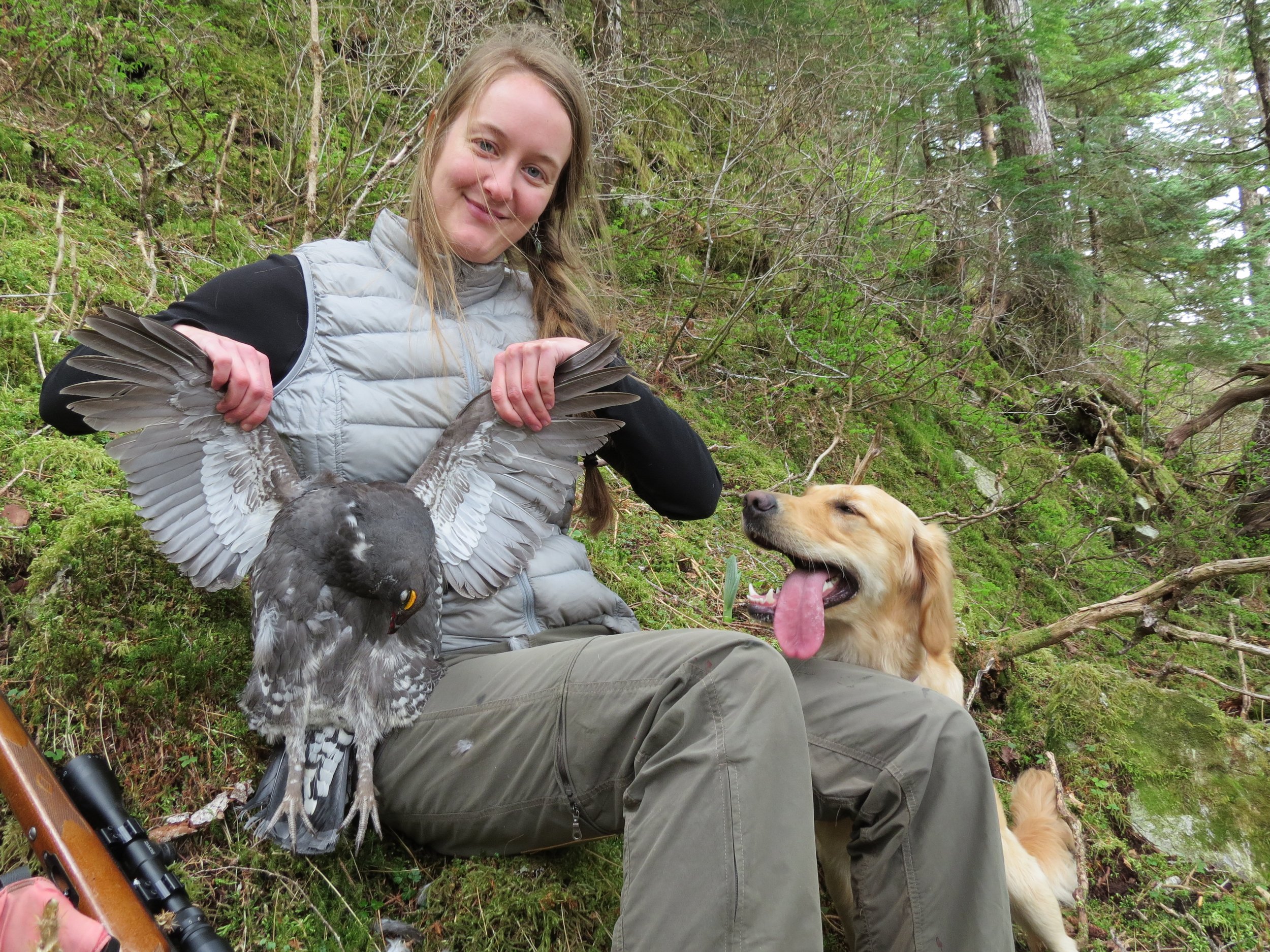
The author and her dog, Fen, with a sooty grouse in Southeast Alaska. Photo by Bjorn Dihle
By Mary Catharine Martin | The Salmon State
Ten years ago, fish research biologist Ryan Bellmore assessed how many salmon the Tongass National Forest contributes to commercial fisheries. The number turned out to be huge — 75% of 50 million salmon caught commercially in Southeast Alaska each year, and 25% of Alaska’s total salmon catch, comes from the Tongass.
“I started thinking about the way the forest provides a diversity of services to people. Humans are a part of the food web. There are not many places that’s more clear across the U.S. than communities here in Alaska,” he said.
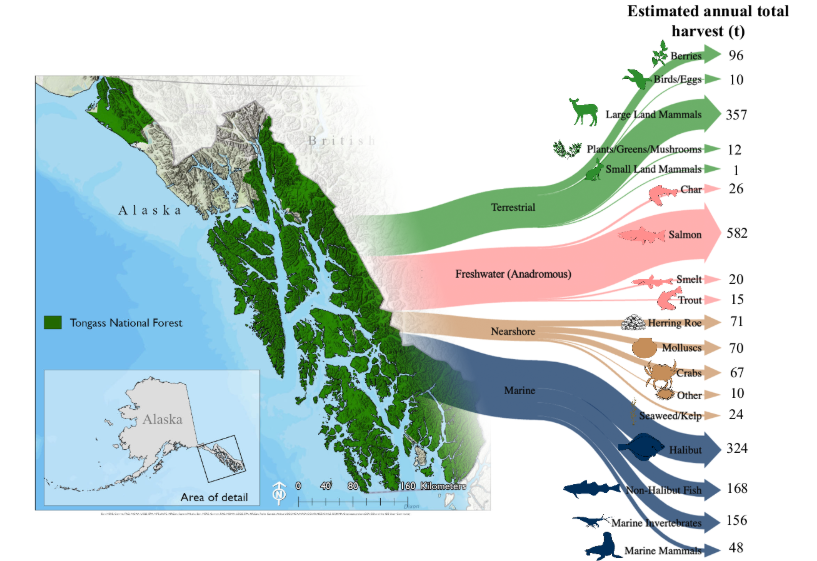
A map of coastal communities in southern Alaska whose harvest data was included in the paper Wild food portfolios: access to diverse foods stabilizes harvest in wild food systems. Image courtesy of the authors.
Until recently, however, there was no study quantifying just how much value wild foods provide to rural residents — or the importance of incorporating that value into land management. Two new studies shed light on those topics for southern coastal Alaska.
“There was a collective interest in acknowledging that national forests provide more than just timber,” said Marie Gutgesell, a food web ecologist and post-doctoral fellow with the Pacific Northwest Research Station, who was the primary author on one of the papers,Wild food portfolios: access to diverse foods stabilizes harvest in wild food systems. “Harvesting wild foods is an intrinsic part of the way of life of the people in Alaska.”
The study took Alaska Department of Fish & Game surveys of subsistence resource consumption and analyzed them, finding that the more diverse the foods people harvest, the more stable people’s food supply.
They found 96 different foods are harvested across southern coastal Alaska — though, added Bellmore, the real number is likely twice that, since in the surveys, some foods — mussels, berries, rockfish — may be listed in groups instead of by individual species.
Raven Cunningham, Director of the Office of Self-Governance & Tribal Programs at the Native Village of Eyak and a paper coauthor, was working for the Chugach Regional Resources Commission as Tribal Fish and Wildlife Director when she and Gutgesell first connected. The study idea “intrigued me as a subsistence user,” she said. “The whole idea that there is a subsistence economy, and getting it acknowledged, was really fascinating. If you think about it, there is a subsistence economy. It’s not monetary, but people share. They go out together. And there’s this whole community that’s embedded into this economy.”
Cunningham said one of the major takeaways from the study for her is that having local managers, including locally-located Forest Service managers, is incredibly important. “People who live in the community, and understand the nuances and the politics, and the uses of resources — nobody can do management better than the people with boots on the ground, who have this deep understanding of this subsistence economy,” she said.
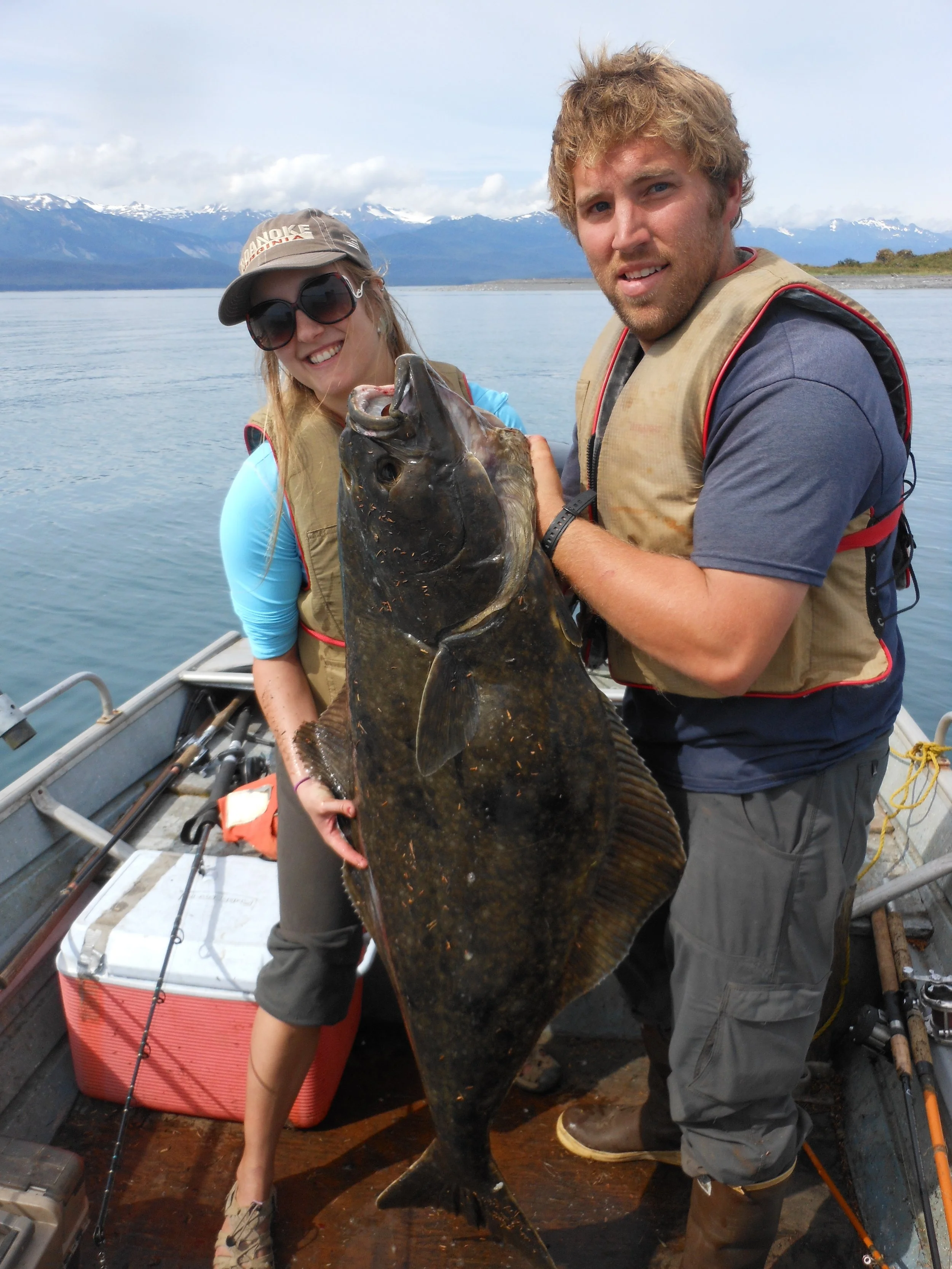
The author and her partner, Bjorn, with a Southeast Alaska sport-caught halibut. Photo courtesy of Mary Catharine Martin | SalmonState
Things are shifting right now, Bellmore said, “faster than they may have ever shifted” — from storms potentially limiting boat activity during particular harvest windows, to fluctuating salmon availability. Management that can keep up with these changing conditions may be important for maintaining food security in the future.
“It also means that when we do a land management action — harvesting timber, putting in a mine, commissioning or decommissioning roads, putting in a boat ramp, or a cabin — all of these things have the potential to affect wild food abundance and people’s access to those foods,” he said.
The second study,Provisioning food and medicine from public forests in the United States, takes a more national approach, finding that “Each year, [more than] 255 thousand metric tons [562,178,769 pounds] of forest foods and medicines are harvested across public lands of the United States.” That includes Forest Service, Bureau of Land Management, and state-managed lands.
In Southeast Alaska in particular, the study says that “Assuming a replacement value of USD $10–20 per kilogram of wild food, the simple ‘replacement value’ of forest foods in Southeast Alaska communities would be between USD $20.5 million and $41.1 million per year. Based on a [rural] population of approximately 24,312 in 2022, this is equivalent to about $845-$1691 per person.”
“Living in remote, rural Alaska, you need to be able to have access to good food. Our land and our ocean is that access. It’s like our grocery store,” Cunningham said.
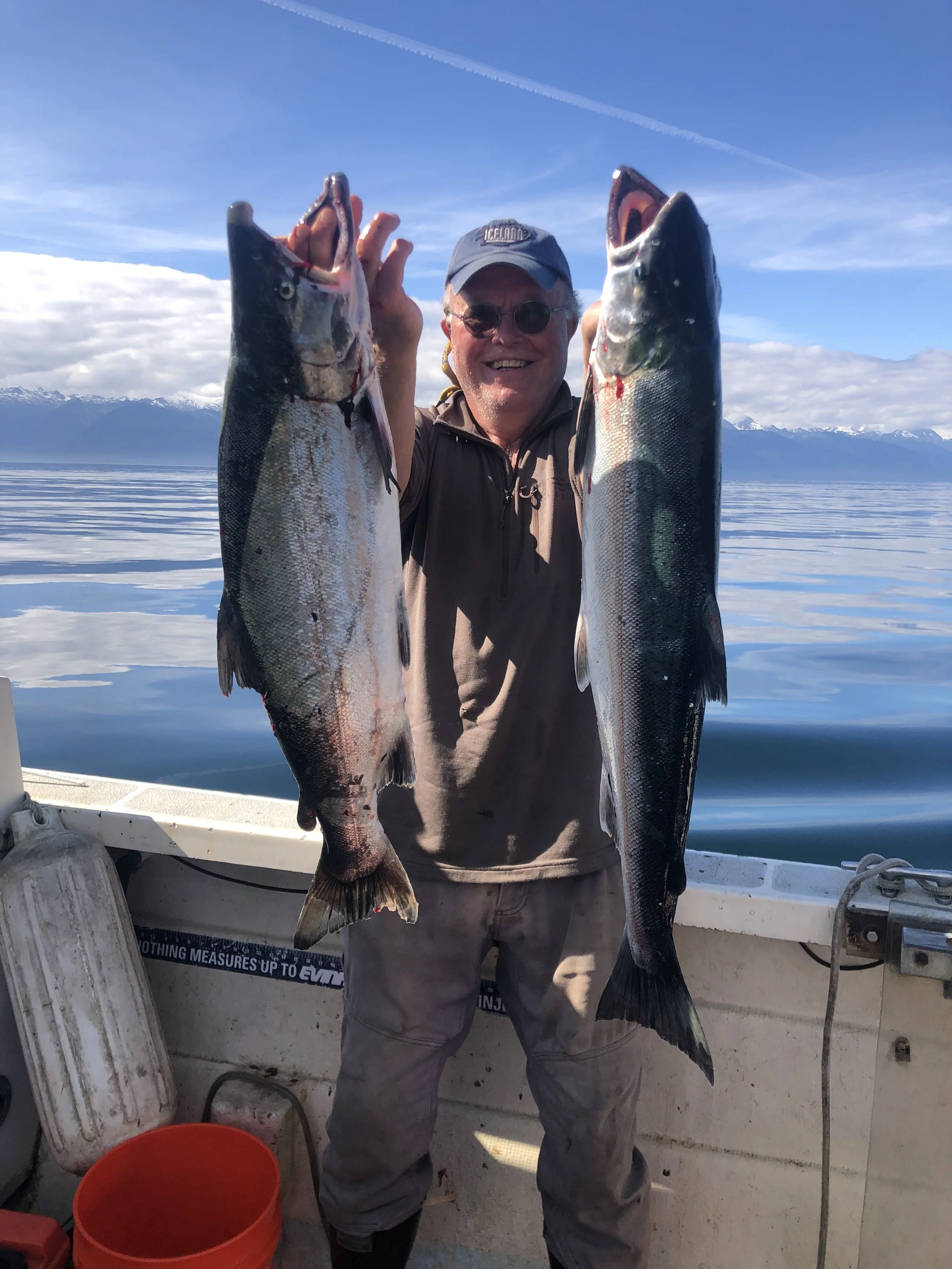
Nils Dihle with a couple of coho salmon caught in August 2025. Photo by Mary Catharine Martin | SalmonState
The studies, which have long been in the works, concluded as the Forest Service pursues a revision of the Tongass Forest Management Plan to align with President Donald Trump’s January 20 and March 1, 2025 executive orders, Unleashing Alaska’s Extraordinary Resource Potential and Immediate Expansion of American Timber Production. That’s something about which many Alaskans have expressed concern, given the Tongass’ role in food production. “The Notice of Intent barely acknowledges or considers the importance of salmon to the commercial fishery industry particularly salmon fisheries,” wrote the Southeast Alaska Fishermen’s Alliance, which represents more than 300 fishermen, in a comment to the Forest Service.
“I feel like a lot of people take the wild economy for granted,” Cunningham said. “Being able to have our freezers full of food that we’ve harvested from the land — it’s important. We wouldn’t be able to live here without it.”